How to answer 'Tell me about yourself' in a software engineering interview
Understanding the 'Tell Me About Yourself' Question
Understanding the 'Tell Me About Yourself' Question
Why Interviewers Ask This Question
The seemingly simple "tell me about yourself" question serves multiple strategic purposes that extend far beyond breaking the ice. While it does help ease interview tension, interviewers primarily use this opener to evaluate how you organize and communicate complex information under pressure—a skill that modern software engineering roles demand when making critical decisions with incomplete data [4].
Your response reveals what you consider most important about your professional identity and whether you've done the homework to understand what the role actually requires. Interviewers value the process of how you think through your narrative more than a perfectly polished delivery [6]. They're assessing cultural fit and whether your career trajectory naturally aligns with the company's direction—particularly important as applicant volume has increased while candidate quality has become harder to evaluate due to AI-enhanced applications [4].
Perhaps most importantly, your answer creates natural segues for follow-up questions that interviewers want to explore, essentially allowing you to control the conversation's direction.
Common Mistakes to Avoid
However, many candidates undermine this opportunity through predictable missteps. The most common error is treating the question as an invitation to chronologically recite your entire resume, starting from your first job out of college. This approach wastes valuable interview time and bores interviewers who already have your resume in front of them.
Equally problematic is beginning with personal life details—where you grew up, your childhood interests, or family background—when interviewers expect a professional focus. They're not conducting a biography interview; they're assessing your fit for a specific role.
Striking the right tone also proves challenging. Being too modest downplays your genuine accomplishments, while being too boastful creates skepticism about your self-awareness and ability to work collaboratively. Both extremes paint an inaccurate picture of your capabilities.
Finally, rambling without structure signals poor communication skills and lack of preparation—two red flags that immediately concern hiring managers. A disorganized answer suggests you'll struggle to communicate clearly with colleagues, clients, and stakeholders.
The Strategic Framework for Your Answer
The most effective answer follows a simple chronological structure: present, past, future. Begin with your current role and key responsibilities, then briefly trace the path that led you there, and conclude with why this opportunity excites you. This reverse-chronological approach keeps interviewers engaged while building logical momentum toward your interest in their position.
Focus your narrative on experiences directly relevant to the job description. If applying for a data engineering role, emphasize your work with Apache Spark pipelines rather than unrelated side projects. Select two or three technical accomplishments that showcase skills the position requires, and quantify your impact wherever possible—"reduced processing time by 40%" carries far more weight than "improved system performance."
Your conclusion should connect your background to this specific opportunity. Research the company's challenges, recent initiatives, or technical stack, then explain how your skills align with their needs. This demonstrates genuine interest beyond simply wanting any job, positioning you as someone who's thoughtfully considered how you'd contribute to their team's success.
Crafting Your Software Engineering Narrative
Presenting Your Current Role and Technical Expertise
Currently, I'm a Senior Software Engineer at TechCorp, where I work primarily with Python, React, and AWS to build scalable microservices architectures. My daily work involves designing distributed systems that handle millions of requests while maintaining 99.9% uptime.
My most significant recent achievement was leading the redesign of our payment processing system, which reduced transaction latency by 60% and increased throughput to 10,000 transactions per second. This project required deep optimization of our database queries and implementing a caching layer with Redis, ultimately saving the company $2 million annually in infrastructure costs.
I specialize in backend development with a strong focus on system architecture and performance optimization. My expertise spans API design, database optimization, and cloud infrastructure management—skills I've honed over five years of building high-traffic applications.
Looking at your job posting, I noticed you're seeking someone experienced with Python microservices and AWS infrastructure. These technologies form the foundation of my current work, making this role a natural fit for my technical background.
Selecting and Describing Past Experience
In my most recent position at TechCorp, I led the migration of a monolithic application to a microservices architecture using Python and FastAPI, which reduced deployment times by 60% and improved system reliability. This project required me to architect containerized services, implement CI/CD pipelines with GitHub Actions, and manage infrastructure as code using Terraform on AWS—all technologies I see central to your role.
Before that, I spent three years at DataSolutions where I built real-time data processing systems handling millions of events daily. The technical challenge there was optimizing Kafka consumers and designing fault-tolerant distributed systems. Beyond the technical work, I mentored four junior engineers and collaborated closely with product managers to translate business requirements into scalable technical solutions.
I also hold an AWS Solutions Architect certification, which I earned last year to formalize my cloud expertise. These experiences have prepared me to contribute immediately to your team's infrastructure modernization efforts while bringing leadership capabilities to complex technical initiatives.
Connecting to the Target Role
What draws me to this position is your company's commitment to engineering excellence and innovation in cloud-native architectures. I've been following your engineering blog, particularly your recent posts about migrating to microservices and implementing chaos engineering practices. These initiatives align perfectly with my experience leading similar transformations at previous organizations.
The job description's emphasis on building scalable, resilient systems resonates deeply with my career trajectory. My background in both hands-on development and architectural design positions me to tackle the technical challenges you've outlined—from optimizing distributed systems to mentoring junior engineers. I'm particularly excited about the opportunity to work with your modern tech stack and contribute to your platform's evolution.
What excites me most is the chance to combine my technical expertise with leadership responsibilities. Your focus on fostering a collaborative engineering culture and investing in team growth matches my own values. I'm eager to bring my experience in cloud infrastructure, system design, and team development to help drive your engineering initiatives forward.
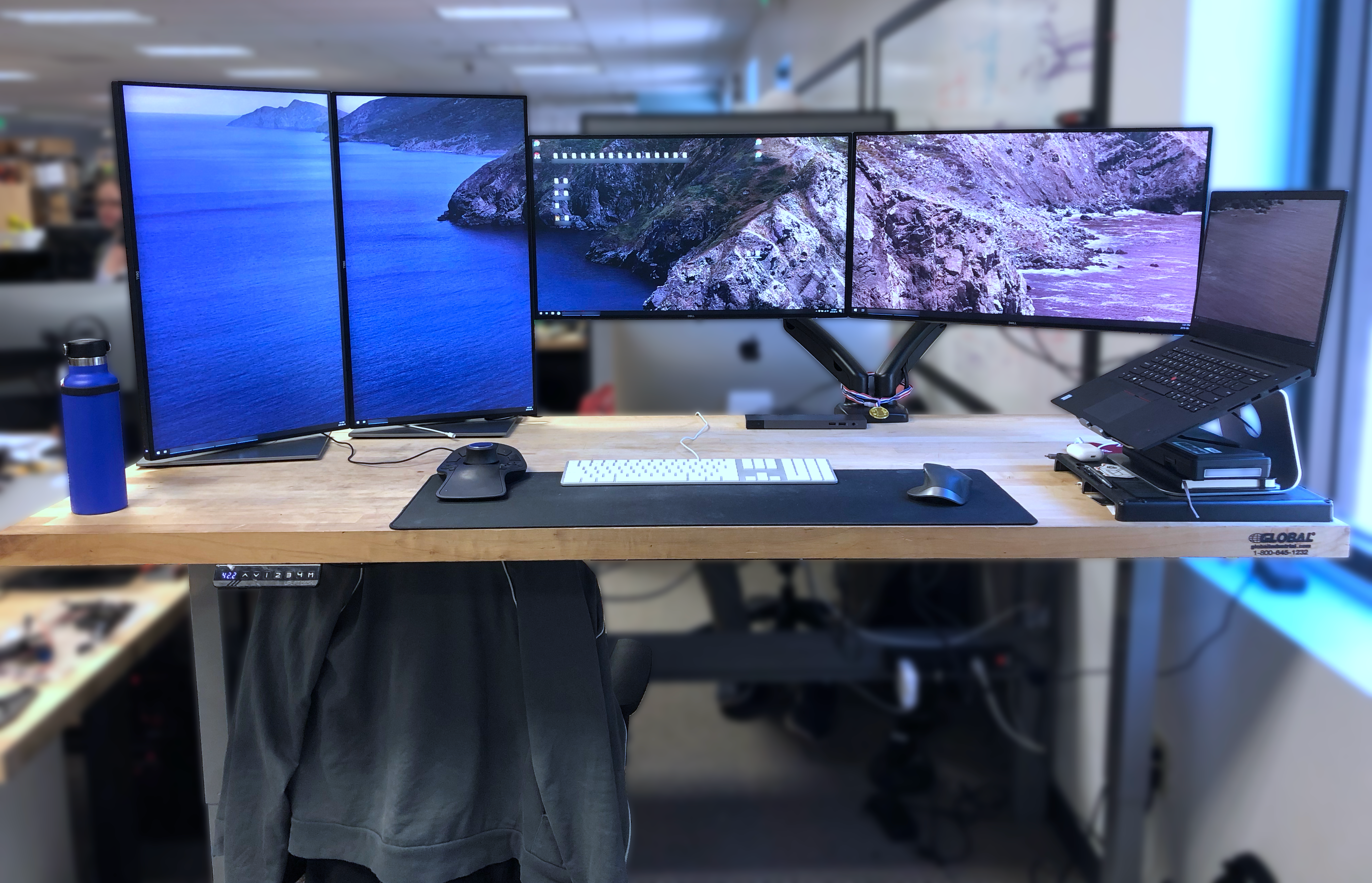
A professional multi-monitor workstation optimized for software engineering productivity.
Delivery, Practice, and Adaptation Strategies
Practicing and Refining Your Answer
The difference between knowing your story and delivering it compellingly lies in deliberate practice. Start by writing out your complete answer, then read it aloud repeatedly until the words flow naturally rather than sounding rehearsed. This vocal practice reveals awkward phrasings that look fine on paper but stumble off the tongue.
Time yourself rigorously. With the 2026 software engineer interview loop typically consisting of five to seven rounds [5], interviewers won't tolerate rambling answers. Your response should land between two and three minutes while hitting every essential point.
Record yourself on video to catch what you can't hear in the moment—filler words like "um" and "like," rushed pacing that suggests nervousness, or sections where your energy visibly drops. These recordings provide objective feedback that self-assessment misses.
Finally, present your answer to software engineering peers or mentors who can evaluate technical credibility. They'll spot vague terminology, questionable claims about your skills, or gaps in your narrative that might raise red flags during actual interviews [8].
Delivering with Confidence and Authenticity
Once you've refined your answer through practice, focus on delivery mechanics that convey confidence. Maintain steady eye contact with your interviewer—breaking away occasionally feels natural, but sustained engagement demonstrates self-assurance in your abilities and experience.
Your body language should reinforce your message: sit up straight, use measured hand gestures when describing technical concepts, and avoid fidgeting or defensive postures like crossed arms. These nonverbal cues often speak louder than your words.
Adopt a conversational tone rather than reciting a memorized script. Let your personality emerge through natural phrasing and occasional humor where appropriate, while maintaining professional boundaries. Vary your pace deliberately—slow down when explaining complex technical decisions, then accelerate slightly through straightforward narrative portions to maintain momentum.
Express genuine enthusiasm for the work you've accomplished and the role you're pursuing. Interviewers recognize authentic passion, but avoid overselling yourself with excessive superlatives or appearing desperate for the position. Your confident, measured delivery should communicate "I'm excited about this opportunity" rather than "I need this job."
Adapting to Different Interview Contexts
Your answer should flex based on your audience. When speaking with HR recruiters, emphasize cultural fit and communication skills while weaving in technical keywords they're screening for [6]. With hiring managers, focus on business impact and how your work solved real problems. Technical peers want to hear about your engineering decisions, trade-offs, and collaboration approach [4].
Phone screens demand efficiency—pack your response with relevant technical terms and concrete metrics that demonstrate your qualifications [2]. In-person interviews allow more storytelling and personality to emerge naturally [6]. At startups like those expanding AI and Machine Learning capabilities, highlight your versatility and direct impact on products [1]. For established companies hiring across multiple regions, emphasize scale, cross-functional collaboration, and systematic approaches [1].
Prepare both a 30-second elevator version and a 90-second detailed narrative. The shorter version hits your core qualifications quickly; the longer one adds context and storytelling depth. Practice transitioning smoothly between them so you can adapt when interviewers redirect or time constraints emerge [5].
Try InterviewWhisperer on your next interview
A native macOS assistant that hears the question and answers on your screen — invisible to the screen share. Verify it on your own Mac before you pay.