How to research a company before an interview
Understanding Why Company Research Matters
Understanding Why Company Research Matters
The Competitive Advantage of Preparation
Walking into an interview armed with deep company knowledge transforms you from just another applicant into a standout candidate. When you demonstrate genuine interest through thoughtful research, you signal initiative that most candidates overlook. Researching a company before an interview provides a competitive advantage when multiple candidates are applying for the same position [10].
This preparation goes beyond impressing interviewers. Understanding a company's specific challenges allows you to position your skills as targeted solutions rather than generic qualifications. You'll craft responses that directly address their needs, making your value proposition immediately clear [7].
The psychological benefits prove equally valuable. Candidates should dedicate several hours to preparation in the days preceding an interview [7], which significantly reduces anxiety and builds confidence in your responses. When you know the company inside and out, you speak with authority rather than uncertainty.
Finally, your research serves a dual purpose. Interviews serve as an opportunity for the candidate to evaluate the company as well as for the company to evaluate the candidate [7]. Armed with cultural insights, you can assess whether this opportunity truly aligns with your career goals before committing.
What Interviewers Expect from Candidates
Understanding cultural expectations naturally leads to recognizing what hiring managers look for during interviews. When you walk into that meeting room, interviewers immediately begin assessing whether you've invested time learning about their organization. They expect candidates to grasp fundamental details—the company's mission, core products or services, and recent developments that shape its direction.
Your preparation becomes evident through the questions you ask. Thoughtful inquiries rooted in research demonstrate professionalism and genuine engagement with the opportunity. Conversely, generic questions that could apply to any company signal you haven't done your homework. This lack of preparation communicates disinterest, often eliminating you from consideration regardless of your qualifications.
Beyond interview performance, your research extends to practical considerations. Understanding the company's culture helps candidates determine appropriate attire for the interview [10], ensuring you present yourself in alignment with organizational norms. These details matter because they collectively demonstrate respect for the interviewer's time and serious interest in joining their team.
Setting Your Research Goals
Effective research begins with clarifying your objectives. You need to assess four critical areas: the company's financial stability and market position, its workplace culture and values, its growth trajectory and future plans, and how these factors align with your career aspirations. This isn't merely about gathering ammunition to impress interviewers—it's about evaluating whether this opportunity represents genuine mutual fit [3].
Automated resume filtering systems already eliminate countless candidates before human review [14], making your research-driven interview performance crucial. Invest 2-3 hours investigating each company before your interview. Create a systematic research checklist covering company news, leadership profiles, recent projects, competitor landscape, and employee reviews. This structured approach ensures comprehensive preparation while preventing information overload.
Remember that research serves dual purposes: demonstrating your serious interest and protecting your own career decisions. Consider that 51% of job seekers withdraw their candidacy due to low job offers [19]—thorough upfront research helps you avoid pursuing misaligned opportunities altogether.
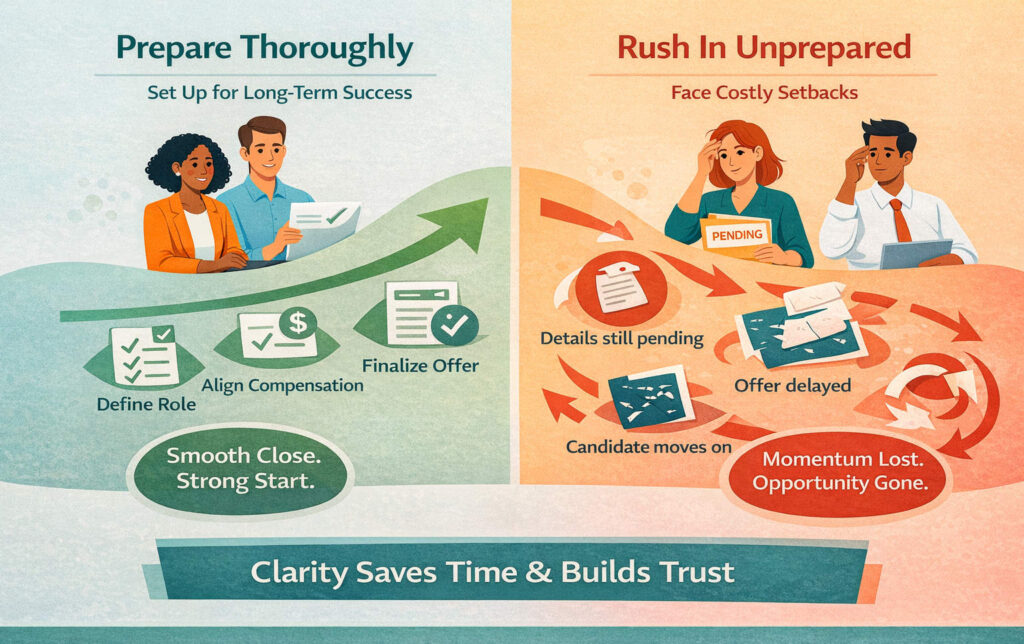
A comparison between a prepared hiring process that leads to success and an unprepared approach that results in lost momentum.
Gathering Essential Company Intelligence
Financial Health and Business Performance
Understanding a company's financial foundation reveals whether you're joining a sinking ship or a rising star. For publicly traded companies, start with the income statement and cash flow data, which typically appear in three distinct sections [1]. The 10-K annual report offers comprehensive financial details required by regulators [1]. Look beyond surface numbers—financial analysis helps identify vulnerabilities like excessive debt that could threaten your future employment [5].
Examine revenue trends to gauge momentum. A company showing 4.2% year-over-year growth [5] demonstrates steady progress, while declining revenues signal potential trouble. For private companies, research recent funding rounds, acquisitions, or expansion announcements through industry publications and news sources. These indicators reveal investor confidence and growth trajectory.
Finally, position your target company within its competitive landscape. Review industry reports to understand market share, emerging threats, and growth opportunities. This context helps you assess whether the organization can sustain long-term employment and career advancement.
Company Culture and Employee Experience
Beyond financial metrics, understanding the human side of an organization reveals whether it's truly a place you want to work. Glassdoor serves as a valuable resource for researching employee reviews and company culture [7], where a significant majority of users are either actively seeking employment or open to new roles [4]. Employee reviews typically cover compensation, growth opportunities, and work-life balance [17]—patterns that emerge across multiple testimonials often reflect genuine organizational strengths or weaknesses.
Pay particular attention to how leadership responds to criticism. Companies that engage constructively with negative feedback demonstrate accountability and openness to improvement [17]. Meanwhile, defensive or absent responses may signal leadership disconnect.
For deeper insights, leverage LinkedIn to connect with current or former employees [16]. More than 65 million companies maintain a presence on LinkedIn to connect with stakeholders [4], making it an ideal platform for authentic conversations. These direct exchanges often reveal unfiltered perspectives about management style, career development paths, and daily work realities that formal reviews rarely capture.
Products, Services, and Strategic Direction
Understanding a company's products and services reveals how they create value and where they're headed. Start with their official website to catalog their offerings, then dig into recent product launches and strategic partnerships that signal future direction [17]. These initiatives often indicate where resources are flowing and which skills will be most valuable.
Press releases provide the company's official narrative about achievements and direction, while news articles offer external perspectives on challenges and market position [18]. Pay special attention to quarterly earnings calls and investor presentations, which outline strategic priorities and growth areas. Look for patterns: Is the company expanding into new markets? Pivoting their product strategy? Investing heavily in specific technologies?
Connect these insights to your target role. If they've just launched a new product line, how would your skills support its growth? If they're facing specific challenges mentioned in recent coverage, how does your experience position you as part of the solution? This research transforms you from an applicant into a strategic asset.
Applying Your Research During the Interview
Tailoring Your Responses with Company Knowledge
Your research transforms into interview gold when you weave it naturally into your responses. When the interviewer asks why you're interested in the role, skip generic praise and reference concrete initiatives: "I'm particularly excited about your recent expansion into sustainable packaging solutions, especially given my background in supply chain optimization for eco-friendly materials."
Connect your accomplishments directly to their current challenges. If the company is scaling operations, highlight when you managed team growth. If they're entering new markets, discuss your experience with market entry strategies. This demonstrates you've thought beyond landing the job—you're already problem-solving for them.
Adopt their language organically. If they emphasize "customer obsession" rather than "customer service," mirror that terminology. When discussing your potential contributions, ground them in market realities: "Given your position as the third-largest player in the regional market, my experience helping mid-sized competitors differentiate through innovation could accelerate your growth trajectory."
This approach proves you're not just qualified—you're already thinking like an insider who understands their specific context and challenges.
Asking Questions That Showcase Your Preparation
Your questions reveal as much about you as your answers do. Instead of asking generic queries about company culture, reference specific initiatives you discovered. For instance, if you learned about their Recruitment Process Outsourcing (RPO) expansion—a sector experiencing higher growth than traditional placement fees [13]—ask how your role would support this strategic shift.
Connect your questions to recent announcements. If the company just launched a new product line or entered a market, explore how your position contributes to that success. When discussing interim roles, which help companies navigate hiring freezes and budget constraints [20], ask about their approach to building flexible talent pipelines.
Address industry challenges you've identified through news and analysis. Question leadership about their response to market trends or competitive pressures—this demonstrates strategic thinking beyond your immediate responsibilities.
Skip questions with obvious answers on their website. Asking "What does your company do?" wastes valuable time and signals poor preparation. Instead, probe deeper into execution strategies, team dynamics, and how they measure success in areas relevant to your role.
Evaluating Fit Based on Your Findings
Your research becomes most valuable when evaluating whether this opportunity truly fits your career goals. Compare the company's stated values against employee reviews and interview experiences. If leadership emphasizes innovation but former employees describe rigid hierarchies, that disconnect matters.
Financial health indicators from your research—funding rounds, revenue growth, market position—help assess long-term stability. A company burning through cash without clear paths to profitability may not offer the security you need, regardless of how exciting the role sounds.
Cultural fit extends beyond perks and office design. Notice how interviewers interact with each other, whether they genuinely listen to your questions, and if their answers align with what current employees report online. These observations validate or contradict your desk research.
When offers arrive, trust your findings. If your research revealed consistent concerns about work-life balance or leadership turnover, don't dismiss those red flags because of an attractive salary. Your preparation gives you the confidence to negotiate effectively or walk away from misaligned opportunities.
Try InterviewWhisperer on your next interview
A native macOS assistant that hears the question and answers on your screen — invisible to the screen share. Verify it on your own Mac before you pay.