What to do when your mind goes blank in an interview
Understanding Why Your Mind Goes Blank
Understanding Why Your Mind Goes Blank
The Science Behind Interview Blanks
When you sit across from an interviewer and suddenly can't recall your own accomplishments, you're experiencing a physiological fight-or-flight response triggered by stress [23]. Your brain perceives the high-stakes situation as a threat, flooding your system with stress hormones that interfere with cognitive function.
The interference hypothesis explains this phenomenon scientifically: anxiety impairs performance by consuming limited working memory capacity [9]. Think of your working memory as a mental workspace where you process information and retrieve stored knowledge. When anxiety monopolizes this space with worried thoughts and physical stress responses, less capacity remains for accessing the answers you actually know.
This reaction is remarkably common—research shows that even teachers reported higher anxiety levels than healthcare workers during challenging circumstances [9]. Understanding that blanking stems from normal neurological processes, not personal inadequacy, is your first step toward managing it. You're not failing; your brain is simply responding to perceived pressure in a predictable, biological way.
Common Triggers and Warning Signs
Certain interview moments act as predictable tripwires for mental blanks. Questions about weaknesses, handling conflict, or unexpected "what would you do if..." scenarios frequently catch candidates off guard [15]. Behavioral interview questions, which ask you to describe past situations, can trigger blanks when you're pressed for specific examples [19].
Your body often signals trouble before your mind completely freezes. Common physical symptoms include sweaty palms, elevated heart rate, and racing thoughts [8]. You might notice shallow breathing, muscle tension, or tunnel vision as anxiety builds [16]. These manifestations of performance anxiety stem from your brain's threat response system activating during high-pressure evaluation [16].
Identifying your personal triggers transforms preparation from generic to strategic. Track which question types make you most nervous, then practice those scenarios specifically [23]. Recognizing early warning signs—that first flutter of panic or sudden mental fog—creates a crucial intervention window. Catching anxiety at this stage, before it escalates into full mental shutdown, dramatically improves your ability to recover and respond effectively.
Why Preparation Alone Isn't Enough
Over-rehearsing your interview responses creates a paradoxical trap. When you memorize answers word-for-word, you transform the interview into a high-stakes recital where any deviation feels like failure [24]. This perfectionist approach amplifies anxiety rather than reducing it, because your brain now monitors for exact recall instead of natural conversation.
The disconnect between practice and performance runs deeper than most candidates realize. Your cognitive abilities under stress operate fundamentally differently than during calm preparation [25]. That brilliant answer you rehearsed flawlessly at home accessed neural pathways in a relaxed state—pathways that stress hormones actively disrupt during actual interviews.
Effective interview readiness requires a dual approach. Content knowledge provides the foundation, but without stress management techniques, that knowledge becomes inaccessible precisely when you need it most [26]. Think of preparation as building a house: you need both solid materials (your knowledge) and a stable foundation (emotional regulation). The most thoroughly prepared candidates still blank when anxiety floods their system, because they've trained only half of what interviews actually demand.
Immediate Recovery Techniques When Blanking Occurs
Breathing and Grounding Methods
When your mind suddenly goes blank, your body's stress response has hijacked your cognitive function. The fastest way to regain control is through deep diaphragmatic breathing, which activates the parasympathetic nervous system and counteracts the panic response [8]. This isn't about calming down eventually—it's about restoring mental clarity within 30-60 seconds.
The 4-7-8 breathing technique offers a precise framework: inhale through your nose for 4 counts, hold for 7, then exhale slowly through your mouth for 8 counts. This extended exhale signals your nervous system that the threat has passed, allowing rational thought to return.
Simultaneously, employ grounding techniques to anchor yourself in the present moment. Feel your feet firmly planted on the floor. Notice the texture of the chair beneath you. These physical sensations interrupt the mental spiral and redirect your attention outward. By reframing nervous energy as excitement [8], you transform physiological arousal from a liability into an asset—the same adrenaline that caused the blank can fuel your recovery.
Verbal Strategies to Buy Time
When your mind blanks, strategic verbal responses create recovery time while maintaining professional credibility. Begin by acknowledging the pause directly: "That's an excellent question—let me think for a moment" [15]. This honest approach demonstrates thoughtfulness rather than confusion, signaling to interviewers that you're formulating a considered response.
If the pause extends, ask for clarification or request that the interviewer repeat the question. Repeating your understanding of a question back to the interviewer can prompt them to provide more information [15], restarting your cognitive process through active listening rather than passive recall.
Paraphrasing the question aloud engages different neural pathways, transforming reception into production. This technique mirrors how framing questions as story prompts produces more honest and detailed responses [19]. Use transitional phrases like "To address that comprehensively..." or "Let me break that down..." These verbal bridges signal deliberate analysis, converting silence from a weakness into evidence of careful consideration.
Nonverbal Communication During Recovery
Your body language during recovery can transform a blank moment from a liability into an asset. Maintain steady eye contact and keep your posture open—shoulders back, hands visible—to project confidence even as your mind regroups [25]. Strategic eye contact signals engagement rather than panic, while nodding three times can encourage the interviewer to elaborate, buying you processing time [25].
Avoid negative nonverbal cues that broadcast anxiety: excessive fidgeting, looking down, or crossing your arms defensively. These signals amplify the perception of struggle. Instead, a brief pause accompanied by purposeful body language—perhaps a slight forward lean or a thoughtful hand gesture—appears deliberate rather than blank [22]. Physical gestures can actually assist memory recall and improve articulation [22].
Remember: interviewers evaluate your recovery composure more than the initial blank moment. How you navigate stress demonstrates professional resilience. A composed pause followed by a structured response showcases problem-solving under pressure—precisely what employers seek in high-stakes roles.
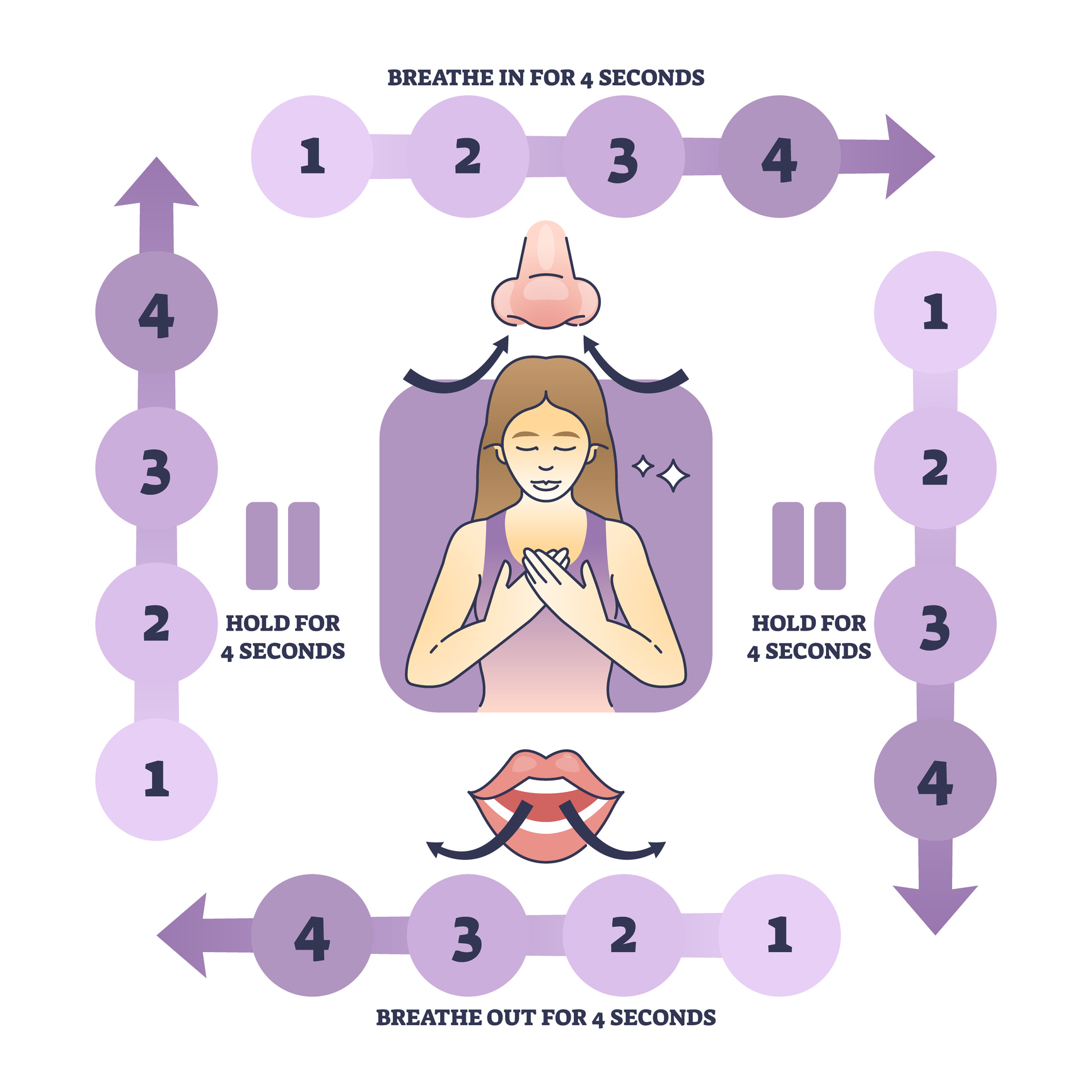
A step-by-step guide to the box breathing technique for stress reduction.
Long-Term Prevention and Building Interview Resilience
Strategic Practice and Visualization
Your brain doesn't distinguish sharply between vividly imagined experiences and real ones. Spend five minutes before bed visualizing yourself entering the interview room, breathing steadily, and answering questions with calm confidence. This mental rehearsal creates neural pathways that activate during actual interviews, reducing anxiety when it matters most.
But visualization alone isn't enough. Practice must mirror reality's pressure. Conduct mock interviews in professional clothing, with unfamiliar interviewers asking unexpected questions. Record yourself and watch the playback—discomfort now prevents surprises later.
Build stress tolerance progressively. Start with friendly practice sessions, then advance to panel interviews with challenging behavioral questions. Add time pressure. Introduce technical problems mid-interview. Each progressive challenge strengthens your resilience.
Most importantly, rehearse your recovery techniques mentally. Visualize yourself catching a freeze, using your breath anchor, and continuing smoothly. When panic strikes in a real interview, your brain will recognize the pattern and access these practiced responses automatically. Preparation isn't about eliminating nerves—it's about ensuring they don't eliminate your performance.
Reframing Your Interview Mindset
Building on your preparation foundation, the next step is shifting how you perceive the interview itself. Rather than viewing it as an interrogation where you're judged on every word, recognize it as a professional conversation—a mutual exploration of fit 10. This reframing immediately reduces performance pressure and allows your authentic expertise to emerge.
Interviewers use behavioral questions to evaluate how you structure your problem-solving process rather than searching for a single perfect answer 20. They want to see how you think through challenges, anticipate risks, and maintain composure under pressure 20—qualities that translate directly to higher job satisfaction and engagement 20. Authentic thinking consistently outperforms memorized responses, which often increase stress and create robotic delivery 22.
Develop self-awareness about your genuine strengths. When you feel uncertain, strategically redirect conversations toward areas where your experience shines. This isn't evasion—it's demonstrating the professional judgment to leverage your expertise effectively.
Building Sustainable Confidence
Regular professional development maintains baseline confidence by ensuring your skills remain current and marketable. When you invest in learning, you build genuine competence that naturally translates into interview poise.
Document your achievements in a running file—specific metrics, solved problems, positive feedback. Review this evidence before interviews for mental priming. Seeing concrete proof of your capabilities counters imposter syndrome and provides ready examples when needed.
Each interview experience, regardless of outcome, builds resilience for future situations [18]. A blank moment that you successfully recovered from becomes proof of your ability to handle pressure. Even unsuccessful interviews reveal patterns in questions and help you refine responses.
Remember that even experienced professionals experience blanks—recovery skill matters most. The executive who gracefully pauses to gather their thoughts demonstrates more professional maturity than the candidate who stumbles through an unprepared answer. Your ability to acknowledge uncertainty and use setbacks as opportunities for growth distinguishes you as someone who can handle real workplace challenges.
Try InterviewWhisperer on your next interview
A native macOS assistant that hears the question and answers on your screen — invisible to the screen share. Verify it on your own Mac before you pay.